Prevention and screening
Levels of prevention, screening criteria, sensitivity and specificity.
Three levels
Primary prevention acts before the disease, by removing the risk: vaccination, stopping smoking. Secondary prevention acts on early disease that is still silent, through screening. Tertiary prevention limits the complications and after-effects of an established disease.
The level is therefore defined by the moment in the natural history of the disease, not by the nature of the action.
What a test tells you, and what it does not
Sensitivity is the proportion of diseased people detected; specificity, the proportion of non-diseased people correctly classified. These two values are properties of the test and do not depend on prevalence.
Predictive values, however, depend closely on it. Applied to a population where the disease is rare, even a highly specific test produces a majority of false positives among the positive results.
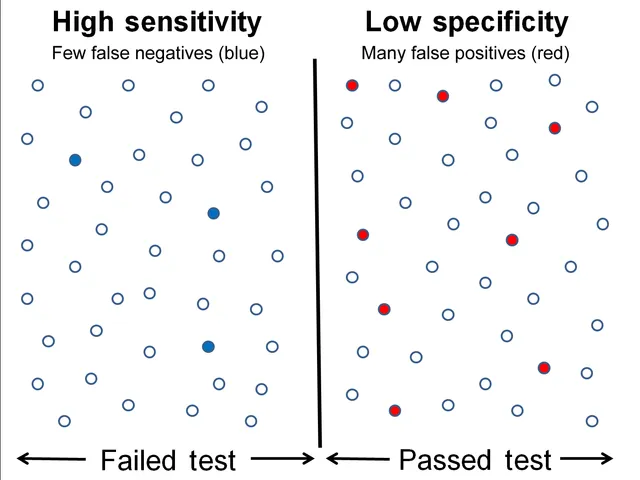

The qualities of a test, and why prevalence changes everything
Sensitivity is the probability that a diseased person tests positive; specificity, the probability that a healthy person tests negative. These two qualities belong to the test and do not depend on prevalence — although they can vary with the spectrum of severity of the patients tested.
Predictive values, however, depend on it heavily. The positive predictive value is the probability of having the disease when the test is positive — and in a population where the disease is rare, it can remain low despite an excellent test.
This is why screening is not done at random. Applied to a low-prevalence population, a high-performing test mostly produces false positives, with their train of follow-up tests, anxiety and risks of their own.
- The disease must be an important health problem, through its frequency or severity.
- It must have a detectable latent phase.
- The test must be acceptable, reliable and low-risk.
- Early treatment must improve the prognosis.
Organised screening in France
Three cancers are subject to organised screening, with personal invitation and coverage of costs. Breast cancer: a mammogram every two years, with clinical examination, for women aged 50 to 74. Colorectal cancer: a home stool test for blood every two years between 50 and 74, followed by colonoscopy if positive. Cervical cancer: from 25 to 65, a cytology test between 25 and 29, then, from 30, a test for high-risk papillomaviruses every five years.
At birth, a drop of blood taken from the heel and placed on blotting paper allows screening for several rare but serious diseases, for which early treatment changes the outlook: phenylketonuria, congenital hypothyroidism, cystic fibrosis, sickle cell disease and others. Hearing screening is also offered.
By contrast, routine PSA testing to screen for prostate cancer is not recommended as organised screening: its benefit on mortality is debated, and the risk of overdiagnosis and overtreatment, with their urinary and sexual after-effects, is substantial.
The pitfalls of evaluating screening
Screening brings forward the date of diagnosis. Even if it changes nothing about the date of death, survival counted from diagnosis appears longer: this is lead-time bias. Longer survival after diagnosis therefore does not prove that screening saves lives.
Periodic screening detects slow tumours, which remain detectable for a long time, more easily than aggressive ones, which appear and cause symptoms between two tests. Screened cases therefore naturally have a better outlook: this is length-time bias. People who take part in screening are also often healthier than those who do not.
Because of these biases, only a randomised trial showing a fall in mortality from the screened disease can demonstrate that screening works. Its drawbacks must also be measured: false positives and unnecessary tests, anxiety, and overdiagnosis, the discovery of lesions that would never have threatened the person but will be treated.
Vaccines
Live attenuated vaccines contain a weakened microbe that multiplies a little without causing illness: measles-mumps-rubella, yellow fever, BCG against tuberculosis. They give strong, lasting immunity but are contraindicated in pregnancy and in people with severely weakened immunity. Inactivated, subunit and toxoid vaccines — the toxin made harmless, as for tetanus and diphtheria — or messenger RNA vaccines cannot cause the disease; they often require several doses and boosters.
In France, mandatory childhood vaccinations rose from three to eleven in 2018: diphtheria, tetanus, polio, pertussis, Haemophilus influenzae b, hepatitis B, pneumococcus, meningococcus C, measles, mumps and rubella. The vaccination schedule, updated every year, specifies ages and boosters, can change these obligations, and recommends other vaccines, such as the papillomavirus vaccine for girls and boys.
Vaccine hesitancy in part of the public is one of the health threats identified by the World Health Organization: when coverage falls, diseases thought to be controlled, such as measles, return. Like all medicines, vaccines are subject to pharmacovigilance.
Acting on risk factors
Tobacco remains the leading cause of avoidable death in France, with about 75,000 deaths per year, ahead of alcohol, responsible for about 41,000 deaths. Next come unbalanced diet, physical inactivity and excess weight. Higher tobacco prices, smoke-free spaces, plain packaging and smoking cessation support have reduced smoking.
Two strategies complement each other. The high-risk approach targets the most exposed people, for example those with severe hypertension. The population approach seeks to shift the average of the whole population slightly, for example by reducing salt in bread. This is Rose's paradox: a large number of people at moderate risk often produces more cases than a small number at high risk, so a measure that brings little to each person can bring a lot to the population.
Health promotion, defined by the Ottawa Charter in 1986, goes beyond disease prevention: it seeks to give people the means to act on their health and its determinants. Therapeutic patient education, for people with chronic diseases, is one application.
58 answered questions go with this chapter in the practice section.
Sources and further reading
Reference textbooks
- Jean Bouyer et coll., Épidémiologie. Principes et méthodes quantitatives, Inserm.
Open access
- Dépistage et prévention du cancer colorectal — Haute Autorité de santé.
Last revised : . Text licensed under CC BY-SA 4.0.