Enzymes and catalysis
Active site, Michaelis-Menten kinetics, inhibition and regulation.
What an enzyme does
An enzyme lowers the activation energy of a reaction. It does not shift the equilibrium and does not make a thermodynamically unfavorable reaction possible: it speeds up the approach to equilibrium, in both directions.
Its specificity comes from the complementarity between the active site and the substrate, a complementarity that adjusts at the moment of binding.
What an enzyme can and cannot do
A reaction with a positive free energy change will not proceed any more in the presence of an enzyme. To make it possible, it must be coupled to a strongly exergonic reaction — hence the universal role of ATP hydrolysis.
Nor is it consumed: a single enzyme molecule can process thousands, even millions, of substrate molecules per second. This is why enzymes are present in tiny amounts compared with their substrates.
Michaelis, and the two ways to inhibit
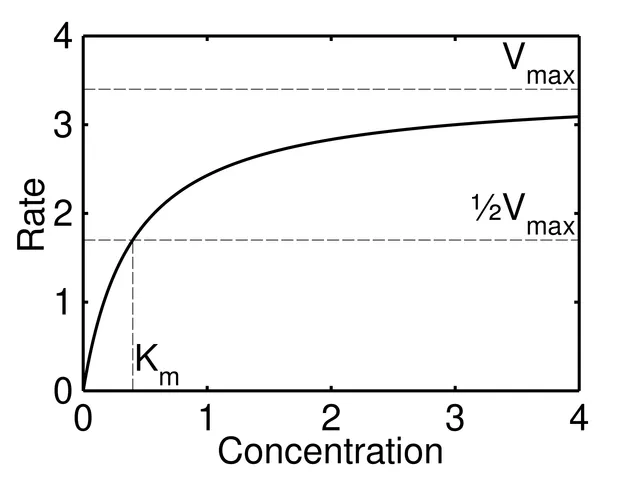
At low substrate concentration, the rate rises almost proportionally. At high concentration, all the enzymes are occupied and the rate levels off: this is the maximum rate. Km is the concentration that gives half of this ceiling. It inversely reflects the enzyme's apparent affinity for its substrate — the lower it is, the less substrate is needed. Many regulatory enzymes do not follow this model, however: their curve is sigmoid, a sign of cooperativity between subunits.
A competitive inhibitor occupies the active site and competes with the substrate. Adding substrate displaces it: the maximum rate can still be reached, but more substrate is needed, so the apparent Km increases.
A noncompetitive inhibitor binds elsewhere and disables the enzyme whatever happens. Adding substrate changes nothing: the maximum rate falls, while Km remains unchanged.

Classifying enzymes
Enzymes are named after the reaction they catalyse, with the suffix -ase, and fall into major classes. Oxidoreductases transfer electrons, like dehydrogenases; transferases move a group from one molecule to another, like kinases, which transfer a phosphate; hydrolases cut a bond by adding water to it, like digestive enzymes.
Lyases cut a bond without water or oxidation, often forming a double bond; isomerases rearrange a molecule without changing its formula; ligases join two molecules while consuming ATP, like DNA ligase, which seals DNA strands. Knowing an enzyme's class therefore already tells you what it does.
Coenzymes and vitamins
Many enzymes need a non-protein partner to work: a metal ion or a small organic molecule, the coenzyme. Most coenzymes derive from the B vitamins, which explains why their deficiencies affect metabolism throughout the body.
- NAD+ and NADP+, derived from vitamin B3, and FAD, derived from vitamin B2: electron carriers in redox reactions.
- Coenzyme A, derived from vitamin B5: carrier of acyl groups, including the acetyl of acetyl-CoA.
- Thiamine pyrophosphate, derived from vitamin B1: essential to pyruvate dehydrogenase; its deficiency, common in alcoholism, affects the brain first.
- Pyridoxal phosphate, derived from vitamin B6: coenzyme of the transaminases.
- Biotin: coenzyme of the carboxylases, which fix carbon dioxide.
- Folate and vitamin B12: transfer of one-carbon groups, needed for DNA synthesis; their deficiency prevents cells from dividing and causes anaemia with large red cells.
Regulating enzyme activity
The cell has several levers. The slowest is to change the amount of enzyme, by regulating its synthesis or degradation: this is how some drugs induce the liver enzymes that break them down. Faster, allosteric regulation changes activity by binding a molecule outside the active site; the end product of a pathway often restrains the first enzyme of that pathway.
Covalent modification is another fast, reversible lever: a kinase adds a phosphate, a phosphatase removes it, and the enzyme switches between active and inactive forms. This is how insulin and glucagon, through opposing cascades, activate or inhibit the same enzymes of glycogen metabolism.
Finally, some enzymes are made as an inactive precursor, the zymogen, activated by cutting off a fragment. The digestive enzymes of the pancreas — trypsinogen, which gives trypsin — and the clotting factors work this way: activation takes place only in the right place, in the gut or at the site of a wound. Premature activation within the pancreas digests it: this is acute pancreatitis.
Temperature, pH and enzymes in the clinic
Each enzyme has an optimal temperature and pH. Beyond the thermal optimum, heat denatures the protein and activity collapses. The optimal pH reflects the environment where the enzyme works: gastric pepsin is most active at a pH of about two, intestinal trypsin at a pH of about eight.
When cells die, their enzymes pass into the blood, where they can be measured. The transaminases, and especially ALT, indicate liver injury; lipase, pancreatitis; creatine kinase, muscle injury; alkaline phosphatase, cholestasis or increased bone activity.
Many drugs are enzyme inhibitors: statins inhibit HMG-CoA reductase, the key enzyme of cholesterol synthesis; aspirin irreversibly inhibits cyclo-oxygenase; allopurinol inhibits xanthine oxidase, which produces uric acid; methotrexate inhibits dihydrofolate reductase and blocks DNA synthesis in dividing cells.
58 answered questions go with this chapter in the practice section.
Sources and further reading
Reference textbooks
- David L. Nelson, Michael M. Cox, Lehninger. Principes de biochimie.
Open access
- 6.5 Enzymes — OpenStax, Biology 2e.
Last revised : . Text licensed under CC BY-SA 4.0.