Flow and vascular resistance
Poiseuille, flow regimes, application to the vascular network.
Poiseuille's law
For laminar flow in a cylindrical tube, resistance varies inversely with the fourth power of the radius. Halving a radius multiplies the resistance by sixteen.
This extreme dependence on radius explains why arterioles, not capillaries, are the resistance vessels of the system: they are the ones that adjust their caliber.
Laminar or turbulent
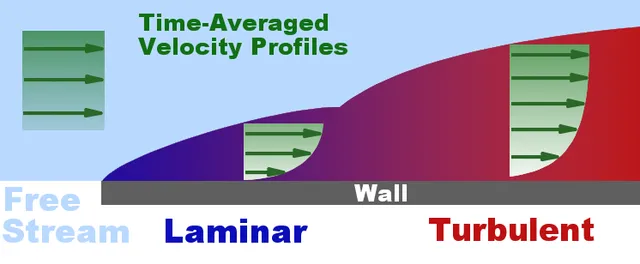
In laminar flow, layers of fluid slide over one another without mixing and the flow is silent. Above a critical velocity, it becomes turbulent: resistance rises abruptly and a sound appears.
This is what makes an arterial narrowing audible, and it is also the principle behind cuff blood pressure measurement: the sounds heard are those of the turbulence created by the compression.

The radius, and the fourth power
Poiseuille's law states that, for laminar flow and at an equal pressure gradient, flow in a tube is proportional to the fourth power of the radius. This is not a detail of the formula: it is one of the keys to circulatory regulation.
Halving the radius divides flow by sixteen. An arteriole therefore does not need to constrict much to radically change what it lets through, which is why arterioles are the body's resistance vessels.
The same law explains the clinical abruptness of stenoses. An artery can narrow for a long time without symptoms, then cross a threshold beyond which flow collapses rapidly. It also explains the choice of a short, wide catheter rather than a long, thin one when fluids must be given fast.
Pressures and units
A pressure is a force divided by an area; its international unit is the pascal. In medicine, the millimetre of mercury is still used, mainly for blood pressure, and the centimetre of water, for low pressures such as those in the airways or cerebrospinal fluid. One millimetre of mercury is about 133 pascals; one centimetre of water about 98 pascals, roughly three quarters of a millimetre of mercury.
In a liquid at rest, pressure increases with depth: hydrostatic pressure equals density times gravitational acceleration times the height of liquid. In a standing person, pressure in the veins and arteries of the feet exceeds that at heart level by about 90 mmHg; at the top of the skull, it is lower instead.
Two practical consequences follow. Blood pressure is measured with the cuff at heart level, otherwise the value is distorted. And an infusion bag hung one metre above the patient exerts a pressure of about 74 mmHg at the vein entry, enough to overcome venous pressure and make the fluid flow.
Flow, cross-section and velocity
In a pipe where no liquid is lost, flow is the same at every level: it equals cross-sectional area multiplied by mean velocity. When the cross-section narrows, velocity rises; when it widens, velocity falls. This is the continuity equation.
Applied to the circulation, it explains why blood is fast in the aorta, whose cross-section is a few square centimetres, and very slow in the capillaries, whose total cross-section, added up over billions of vessels, exceeds two thousand square centimetres. This slowness, less than a millimetre per second, leaves time for exchange.
At a narrowing of an artery or valve, blood speeds up. According to Bernoulli's principle, pressure energy is then partly converted into kinetic energy: lateral pressure falls in the narrow zone. Doppler ultrasound measures this velocity, from which the pressure difference across the narrowing, and hence its severity, can be deduced.
The viscosity of blood
Viscosity measures a fluid's resistance to flow, due to friction between its layers. For water or plasma, it is constant: these are Newtonian fluids. Blood, by contrast, is a suspension of cells: its viscosity depends mainly on the haematocrit, and also on flow velocity. At low velocities, red cells stack up and viscosity rises; at high velocities, they line up and it falls.
In vessels smaller than a few hundred micrometres, red cells concentrate in the centre and leave a layer of plasma against the wall that lubricates the flow: apparent viscosity falls. This phenomenon helps blood pass through the microcirculation.
Polycythaemia, by raising the haematocrit, thickens the blood and promotes thrombosis; anaemia thins it, which increases velocity and can produce a heart murmur without any lesion. Some plasma disorders, in which an immunoglobulin is produced in excess, also raise viscosity and cause visual disturbance, headache and bleeding.
Turbulence and sounds
Laminar flow slides in parallel layers, silently. Beyond a certain threshold, it becomes turbulent: eddies appear, resistance increases and vibrations become audible. The Reynolds number predicts this transition; it increases with density, velocity and diameter, and decreases with viscosity. In a straight tube, turbulence appears above about 2,000.
Heart and vascular murmurs are turbulence sounds: narrowing of a valve, a leak, stenosis of an artery. Measuring blood pressure with a cuff also relies on turbulence: when the cuff, inflated and then deflated, lets blood through an artery that is still partly compressed, the turbulent flow produces sounds heard with the stethoscope between systolic and diastolic pressure.
The wall: Laplace and compliance
Laplace's law links tension in a vessel wall to pressure and radius: for a cylinder, tension is proportional to the product of pressure and radius. At equal pressure, a wide vessel bears greater tension. Once an aneurysm has dilated, its wall is therefore more stretched, which makes it enlarge further; the risk of rupture rises with diameter.
The same reasoning applies to the heart. A dilated ventricle must develop a higher wall tension to produce the same pressure, which increases its work and oxygen consumption: this is one reason why dilatation worsens heart failure.
The compliance of a vessel is the change in volume for a given change in pressure. The elastic aorta distends during systole and gives back this volume during diastole: flow becomes continuous in the small vessels, and diastolic pressure is maintained. The veins, very compliant, hold most of the blood: they form a volume reservoir.
58 answered questions go with this chapter in the practice section.
Sources and further reading
Reference textbooks
- John E. Hall, Michael E. Hall, Guyton et Hall. Physiologie médicale, Elsevier Masson.
Open access
- 12.4 Viscosity and Laminar Flow; Poiseuille's Law — OpenStax, College Physics 2e.
- 12.5 The Onset of Turbulence — OpenStax, College Physics 2e.
- 20.2 Blood Flow, Blood Pressure, and Resistance — OpenStax, Anatomy and Physiology 2e.
Last revised : . Text licensed under CC BY-SA 4.0.