Chemical bonds and states of matter
Covalent and ionic bonds, weak interactions and their biological consequences.
Strong bonds
A covalent bond shares electrons. When the two atoms have different electronegativities, the sharing is unequal: the bond is polarized and carries partial charges.
An ionic bond, by contrast, results from the complete transfer of an electron. In water, these compounds dissociate into ions, which makes them conductive.
Weak bonds, major effects
Taken one by one, weak bonds are negligible. Multiplied by the thousands, they determine the entire structure of living matter.
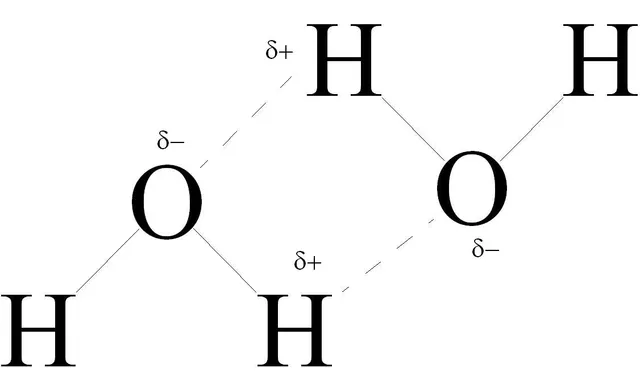
- Hydrogen bonds hold water together, pair the bases of DNA and shape the secondary structure of proteins.
- Hydrophobic interactions gather nonpolar parts away from water: they drive the assembly of membranes.
- Van der Waals forces, very weak and short-ranged, stabilize contacts between complementary surfaces.

Strong and weak, and why both are needed
A covalent bond shares electrons: several hundred kilojoules per mole, stable at body temperature, broken only by an enzyme. This is what holds together a protein's sequence or the backbone of DNA.
Weak interactions — hydrogen bonds, van der Waals forces, ionic interactions, the hydrophobic effect — are worth from a few to a few tens of kilojoules. Taken one at a time, thermal agitation is enough to undo them.
Living matter needs both. Covalent bonds ensure the permanence of information; weak ones ensure that assemblies are reversible. A double helix held together by covalent bonds could never open to be read; an antibody permanently stuck to its antigen could never be recycled.
The atom and its electrons
An atom has a nucleus, made of protons and neutrons, surrounded by electrons. The number of protons, or atomic number, defines the element; two atoms of the same element that differ in their number of neutrons are isotopes. Some isotopes are unstable and radioactive, which nuclear medicine and dating exploit.
Electrons are distributed in shells and subshells of increasing energy. Only those in the outermost shell, the valence electrons, take part in bonds. Atoms tend to reach the stable configuration of the noble gases, with eight electrons in their outer shell: this is the octet rule, which explains how many bonds each element forms — one for hydrogen, two for oxygen, three for nitrogen, four for carbon.
The periodic table arranges elements by increasing atomic number. Elements in the same column have the same number of valence electrons and similar chemical properties; a row, or period, corresponds to filling a new shell.
Covalent, ionic, coordinate
In a covalent bond, two atoms share a pair of electrons. It can be single, double or triple; the more multiple it is, the shorter and stronger it is, and a double bond prevents rotation around the axis joining the two atoms. When the two atoms differ in electronegativity, the electrons are shared unequally and the bond is polarised.
When the difference in electronegativity is very large, one atom gives an electron to the other: two ions of opposite charge form, held by electrostatic attraction. This is the ionic bond, that of sodium chloride. In water, these ions separate, surrounded by water molecules that isolate them.
In a coordinate bond, both electrons of the pair come from the same atom, which "lends" them to a metal ion with empty orbitals. This is how the iron of haemoglobin is held by the nitrogen atoms of haem and binds oxygen, or how many enzymes bind a metal ion essential to their activity.
The shape of molecules
The electron pairs surrounding an atom repel one another and spread as far apart as possible: this principle is enough to predict the geometry of small molecules. Around a carbon bonded to four atoms, the bonds point to the corners of a tetrahedron, about one hundred and nine degrees apart, as in methane.
Lone pairs count too. The oxygen of water carries two bonds and two lone pairs: the molecule is bent, with an angle of about one hundred and four degrees. The nitrogen of ammonia carries three bonds and one lone pair: the molecule is pyramidal.
Geometry decides polarity. Carbon dioxide, linear, has two polarised bonds whose effects cancel out: it is non-polar. Water, bent, keeps a negative pole on the oxygen side and a positive pole on the hydrogen side: it has a dipole moment, the source of its properties as a solvent.
States of matter and gases
Solid, liquid or gas: the state of a substance depends on the balance between thermal agitation, which scatters molecules, and the forces that attract them. The stronger these forces, the more energy is needed to become a gas. Water boils at one hundred degrees, while molecules of similar size without hydrogen bonds, such as methane, are gases at room temperature.
An ideal gas obeys the law PV = nRT: at constant temperature, pressure and volume vary inversely; at constant pressure, volume increases with temperature. In a gas mixture, each gas exerts a partial pressure proportional to its share, and the total pressure is their sum: this is Dalton's law.
Air contains about twenty-one percent oxygen. At sea level, under a pressure of about seven hundred and sixty millimetres of mercury, the partial pressure of oxygen is therefore about one hundred and sixty millimetres; at altitude, total pressure falls, and with it the partial pressure of oxygen, although the proportion stays the same.
Isomerism
Two isomers have the same molecular formula but a different arrangement. Constitutional isomers differ in the sequence of their atoms. Stereoisomers have the same sequence but a different arrangement in space: cis and trans isomers around a double bond, which does not rotate, or enantiomers.
Two enantiomers are mirror images of each other that cannot be superimposed, like a right hand and a left hand. They have the same physical properties, except their effect on polarised light, which they rotate in opposite directions. But living matter, itself made of chiral molecules, tells them apart: proteins contain only L-amino acids, and metabolism uses only D-glucose.
In pharmacology, two enantiomers of a drug can therefore have different effects. The dramatic example of thalidomide, one form of which is sedative and the other teratogenic, also showed that some enantiomers convert into each other in the body: purifying the useful form is not always enough.
58 answered questions go with this chapter in the practice section.
Sources and further reading
Reference textbooks
- Peter Atkins, Loretta Jones, Principes de chimie.
Open access
- 7.1 Ionic Bonding — OpenStax, Chemistry 2e.
- 7.2 Covalent Bonding — OpenStax, Chemistry 2e.
- 10.1 Intermolecular Forces — OpenStax, Chemistry 2e.
Last revised : . Text licensed under CC BY-SA 4.0.