Solutions, concentrations and osmosis
Concentration units, osmolarity and water movement.
Expressing a concentration
Molarity relates an amount of substance to a volume of solution; molality relates it to a mass of solvent. In biology, the first is almost always enough.
Osmolarity counts the osmotically active particles, whatever they are. One mole of sodium chloride releases two moles of particles: a 150 mmol/L NaCl solution therefore has an osmolarity close to 300 mOsm/L.
Osmosis
Across a membrane permeable to water but not to the solute, water moves from the less concentrated medium to the more concentrated one. It does not follow the solute: it follows its own gradient.
A cell placed in a hypotonic medium swells and may burst; in a hypertonic medium, it shrinks. This is why injectable solutions are matched to plasma osmolarity.
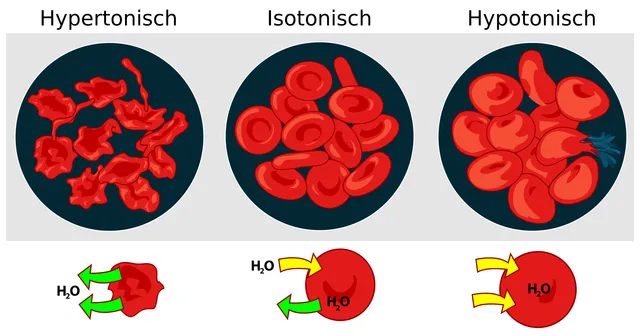

Osmolarity and tonicity, two notions often confused
Osmolarity counts all dissolved particles, without asking whether they cross the membrane. Tonicity only counts those that do not cross it, and which therefore exert a lasting pull on water.
Urea illustrates the gap. A urea solution can have the same osmolarity as plasma, yet it is not isotonic, because urea crosses the membrane freely, equilibrates on both sides and stops having any effect. The cell ends up swelling as it would in pure water.
In clinical practice, this distinction determines the choice of infusions. Normal saline at nine grams per liter is isotonic and stays in the extracellular compartment. Five percent dextrose has the same osmolarity at first, but the glucose is metabolized: in practice it amounts to infusing water, which spreads into every compartment.
Converting between units
Molar concentration, or molarity, counts moles of solute per litre of solution; mass concentration, grams per litre. Molar mass converts one into the other: a sodium chloride solution at 9 g/L, with a molar mass of 58.5 g/mol, contains about 154 mmol/L of NaCl.
Molality counts moles per kilogram of solvent, not per litre of solution. It does not depend on temperature or on the volume occupied by solutes, which makes it more exact in physiology; in plasma, the two differ little.
For ions, the equivalent is also used, which takes charge into account: one millimole of a divalent ion is worth two milliequivalents. A blood calcium of 2.5 mmol/L thus corresponds to 5 mEq/L. This unit makes electroneutrality visible: in plasma, the sum of cation milliequivalents equals that of anions.
Colligative properties
Some properties of a solution depend not on the nature of the dissolved particles but only on their number: they are called colligative. Osmotic pressure is one of them, as are freezing-point depression and boiling-point elevation.
A salt that dissociates into several ions counts as that many particles. Sodium chloride gives almost two; glucose, which does not dissociate, only one. Van 't Hoff's law expresses osmotic pressure as the product of the number of particles by the concentration, the gas constant and the absolute temperature.
In the laboratory, plasma osmolality is measured by cryoscopy: each osmole per kilogram of water lowers the freezing point by about 1.86 degrees. Plasma, at about 290 mOsm/kg, freezes at about minus 0.54 degrees.
Body water and its compartments
Water makes up about sixty percent of the weight of an adult man, slightly less in women and older people, whose fat mass is proportionally larger. Two thirds is inside cells; the remaining third is extracellular, three quarters in interstitial fluid and one quarter in plasma.
Water movements between cells and extracellular fluid follow osmolality: water moves towards the more concentrated compartment. Sodium, the main extracellular osmole, therefore controls cell volume. Hypernatraemia dehydrates cells; hyponatraemia makes them swell, which is dangerous for a brain enclosed in the skull.
Between plasma and interstitial fluid, the Starling balance decides: capillary hydrostatic pressure, which pushes water out of the vessels, against the oncotic pressure of proteins, which holds it back. Loss of salt and water reduces extracellular volume — skin tenting, low blood pressure, rapid pulse; loss of pure water also dehydrates the cells and causes intense thirst.
Diffusion and dialysis
A solute diffuses spontaneously from the more concentrated compartment to the less concentrated one. According to Fick's law, the rate is proportional to the exchange surface and the concentration gradient, and inversely proportional to the thickness to cross; it also depends on the size of the molecule and its solubility in the membrane.
A semipermeable membrane lets water and small molecules through but holds back large ones. This is the principle of haemodialysis: the patient's blood flows on one side of a membrane, dialysis fluid on the other. Excess urea, creatinine and potassium diffuse into the dialysate, which contains none; the proteins and cells of the blood stay on their side.
By setting the composition of the dialysate, one chooses what leaves and what enters: potassium can be removed, bicarbonate supplied, and, by adjusting pressure, water can be withdrawn from a patient whose kidneys no longer eliminate it.
58 answered questions go with this chapter in the practice section.
Sources and further reading
Reference textbooks
- Peter Atkins, Loretta Jones, Principes de chimie.
Open access
- 3.3 Molarity — OpenStax, Chemistry 2e.
- 11.4 Colligative Properties — OpenStax, Chemistry 2e.
Last revised : . Text licensed under CC BY-SA 4.0.