Pharmacokinetics: the four steps
Absorption, distribution, metabolism, elimination.
What happens to a drug
Absorption, distribution, metabolism, elimination: four simultaneous processes, never successive ones. As soon as a molecule is absorbed, its distribution and elimination begin.
Half-life and steady state
With first-order kinetics, about five half-lives are needed to reach steady state with repeated dosing, and just as many to eliminate the drug once it is stopped.
A loading dose reaches the target concentration immediately, without waiting for these five half-lives. It depends on the volume of distribution, not on clearance.
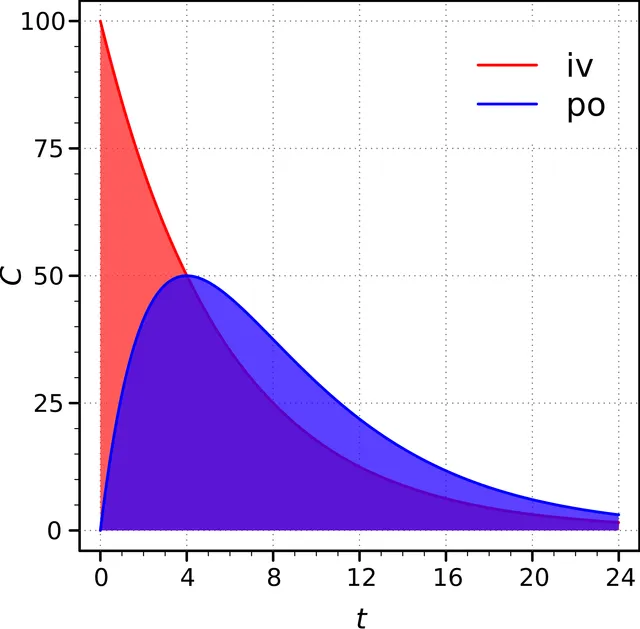

The four steps in the fate of a drug
Absorption moves the active substance into the systemic circulation. By mouth, it crosses the gut wall and then the liver before getting there: this is the first-pass effect, which can destroy most of the dose. Bioavailability measures the fraction that actually arrives, and is one hundred percent by definition for the intravenous route.
Distribution spreads the drug through the body. The volume of distribution is a theoretical volume, the ratio of the dose to the plasma concentration; when very large, it signals a molecule that has left the plasma for the tissues, and is therefore hard to remove by dialysis.
Metabolism, mostly hepatic, transforms the molecule — often to make it more water-soluble and therefore excretable. Elimination, finally, is mainly renal or biliary.
Interactions and patient factors
Hepatic metabolism relies largely on cytochrome P450 enzymes, especially CYP3A4. An inducing drug, such as rifampicin or some antiepileptics, speeds up the breakdown of other substrates and weakens their effect; an inhibitor, such as azole antifungals or clarithromycin, slows it down and exposes to overdose. Grapefruit juice inhibits intestinal CYP3A4.
Patient factors also change kinetics. Kidney failure slows the elimination of drugs excreted unchanged, whose dose must be reduced or intervals lengthened. In older people, reduced glomerular filtration is common even when creatinine looks normal.
Binding to plasma proteins, mainly albumin, also matters: only the free fraction diffuses, acts and is eliminated. Low albumin increases the free fraction of highly bound drugs.
The useful formulas
The volume of distribution links the amount of drug in the body to the plasma concentration: after a single intravenous injection, the initial concentration equals the dose divided by the volume of distribution. Clearance is the volume of plasma completely cleared of the drug per unit time; it is calculated as the absorbed dose divided by the area under the concentration curve.
Half-life depends on both: it equals about 0.7 times the volume of distribution divided by clearance. A half-life therefore lengthens if clearance falls, in kidney failure for example, but also if the volume of distribution increases.
Two doses are calculated this way. The loading dose, which reaches the target concentration at once, equals the volume of distribution multiplied by that concentration, corrected for bioavailability: for a volume of 40 litres and a target of 10 mg/L intravenously, 400 mg. The maintenance dose, which keeps steady state, makes up for what is eliminated: it equals clearance multiplied by the target concentration, per unit time.
Absorption and routes that bypass the liver
Most drugs cross membranes by passive diffusion, in their non-ionised, lipid-soluble form. Ionisation, however, depends on pH: a weak acid is little ionised in an acid medium, a weak base in an alkaline medium. In practice, though, most oral absorption takes place in the small intestine, whose huge surface makes up for the less favourable pH.
After intestinal absorption, blood passes through the portal vein and crosses the liver before reaching the general circulation: this is where the first-pass effect occurs. Some routes avoid it. The sublingual route passes the drug directly into veins that join the vena cava: this is why glyceryl trinitrate, almost entirely destroyed by the liver if swallowed, is taken under the tongue during an angina attack. The transdermal route, by patch, and the injectable routes also avoid it.
The pharmaceutical form also changes absorption. A prolonged-release form spreads out release of the active substance and allows fewer doses per day; it must be neither crushed nor split, or an excessive dose may be released all at once.
Distribution and protein binding
In the blood, many drugs are bound to proteins: weak acids mainly to albumin, weak bases to another plasma protein. Only the free fraction diffuses into tissues, acts and is eliminated. When albumin falls, through malnutrition, cirrhosis or nephrotic syndrome, the free fraction of a highly bound drug increases, and with it the risk of toxicity.
The volume of distribution is a notional volume, not an anatomical one. A drug that stays in the plasma, like heparin, has a small volume, close to that of plasma. A drug that binds massively in the tissues, like digoxin, can have a volume of several hundred litres, far more than the body's volume: it simply signals that the plasma concentration is low compared with the amount present in the body.
Dialysis efficiently clears only drugs with a small volume of distribution and low protein binding: a drug stored in the tissues is barely accessible to the filter.
Two phases of metabolism, and paracetamol
The liver converts drugs into more water-soluble compounds, easier for the kidney to eliminate. Phase I reactions — mainly oxidations, by cytochrome P450 enzymes — modify the molecule; phase II reactions conjugate it to a large polar molecule, such as glucuronic acid, a sulphate or an acetyl group.
Metabolism does not always inactivate. Some drugs are prodrugs, inactive until the liver has converted them: codeine must be converted into morphine by a cytochrome whose activity varies with genes. In ultrarapid metabolisers, excessive conversion can cause morphine overdose, with deaths reported in children; in poor metabolisers, codeine is barely effective. Likewise, for phase II, slow acetylators eliminate some drugs more slowly and suffer more of their side effects.
Paracetamol illustrates what happens when a pathway saturates. At usual doses, it is conjugated and eliminated safely; a small fraction is converted into a toxic derivative, immediately neutralised by glutathione. In overdose, conjugation saturates, the toxic derivative accumulates, glutathione runs out, and liver cells die. The antidote, N-acetylcysteine, replenishes glutathione; it is all the more effective the earlier it is given.
Elimination and special populations
The kidney eliminates drugs by glomerular filtration of the free fraction and by active tubular secretion, and reabsorbs part of them. Reabsorption depends on urinary pH: making the urine alkaline ionises weak acids, which are then no longer reabsorbed; this technique is used in some aspirin poisonings. Other drugs are eliminated in bile; some are reabsorbed by the gut and return to the liver, in an enterohepatic cycle that prolongs their action.
The newborn has an immature liver and kidneys: conjugation is weak, and some drugs accumulate dangerously. Older people combine reduced kidney function, a larger fat mass, which increases the volume of distribution of lipid-soluble drugs and prolongs their action, and often many treatments: one starts with low doses and increases slowly.
Liver failure reduces metabolism and albumin production, and the first-pass effect diminishes: a drug normally heavily destroyed by the liver becomes much more available after oral intake.
58 answered questions go with this chapter in the practice section.
Sources and further reading
Reference textbooks
- Humphrey P. Rang et coll., Rang & Dale. Pharmacologie, Elsevier Masson.
Open access
- Pharmacocinétique — Collège national de pharmacologie médicale.
Last revised : . Text licensed under CC BY-SA 4.0.