Receptors and dose-response
Affinity, efficacy, agonists, antagonists and therapeutic index.
Affinity and efficacy
Affinity measures a molecule's ability to bind the receptor; efficacy, its ability to activate it once bound. The two are independent, and their combination defines the type of ligand.
An agonist has both affinity and efficacy. An antagonist has affinity but no efficacy: it occupies without activating, and its effect only exists relative to the ligand it displaces. A partial agonist has intermediate efficacy, whatever the dose.

The therapeutic index
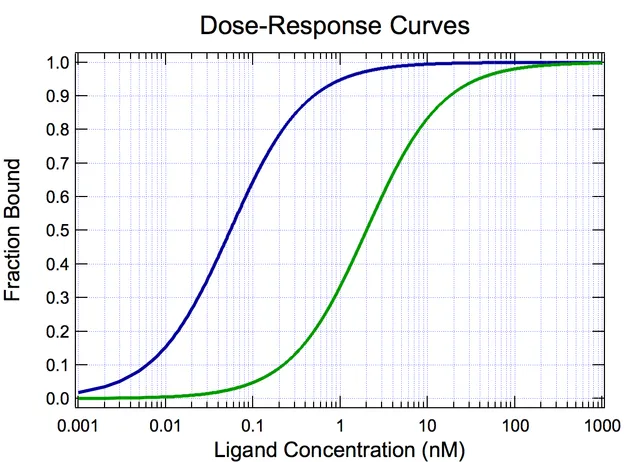
The same dose-response curve can describe the desired effect and the toxic effect. The therapeutic index measures the gap between the two: the narrower it is, the less room for maneuver.
A narrow-index drug requires concentration monitoring, because a modest change in dose or clearance is enough to tip from underdosing to overdosing.
Potency and efficacy
Potency and efficacy are not the same thing either. A potent molecule acts at a low dose; an effective molecule produces a high maximal effect. A drug can be very potent and not very effective, and vice versa.
The main families of receptors
G-protein-coupled receptors are the largest family and the target of a large share of drugs: adrenergic, muscarinic, opioid and dopamine receptors. Their activation triggers a second-messenger cascade, which amplifies the signal but makes it slower.
Ion-channel receptors open an ion pore as soon as the ligand binds: the nicotinic receptor of the motor end plate, the GABA-A receptor. Their effect is measured in milliseconds. Enzyme-linked receptors, such as the insulin receptor, carry tyrosine kinase activity; nuclear receptors, targets of corticosteroids and thyroid hormones, act on transcription, within a few hours.
Prolonged exposure to an agonist often reduces the response: this is desensitisation, or tachyphylaxis when it is rapid. Conversely, a prolonged antagonist can increase the number of receptors, which explains the rebound effect when a beta-blocker is stopped abruptly.
Affinity, occupancy and spare receptors
Binding of a drug to its receptor follows the law of mass action: it is reversible, and the proportion of occupied receptors increases with concentration. The dissociation constant, written KD, is the concentration at which half the receptors are occupied. The lower it is, the stronger the affinity: less drug is needed to occupy the receptors.
The effect is not always proportional to occupancy. In many tissues, a full agonist produces its maximal effect while occupying only part of the receptors: the others are spare receptors. The concentration giving half the maximal effect, the EC50, is then lower than the KD.
These spare receptors explain why an irreversible antagonist, at low dose, may not reduce an agonist's maximal effect: the reserve must first be used up before the maximal effect falls.
Reading a dose-response curve
Plotting effect against the logarithm of concentration gives an S-shaped curve. Its plateau is the maximal effect, which measures efficacy; its horizontal position, marked by the EC50, measures potency. A more potent drug has a curve shifted to the left; a more efficacious drug has a higher plateau.
A competitive antagonist occupies the same site as the agonist, reversibly. It shifts the agonist's curve to the right without lowering its plateau: its effect can be overcome by high doses of agonist. A non-competitive or irreversible antagonist instead lowers the plateau, and no dose of agonist restores the maximal effect.
Naloxone is a competitive opioid antagonist: it reverses the respiratory depression of an overdose within minutes. Its duration of action is shorter than that of many opioids: when it wears off, respiratory depression can return, hence prolonged monitoring. Buprenorphine, a partial agonist at the same receptors, has a capped effect that limits respiratory risk, and it can trigger withdrawal in a patient dependent on a full agonist.
Drug targets, by example
G protein-coupled receptors are the most common target: beta-blockers at adrenergic receptors, antihistamines at H1 receptors, morphine-like drugs at opioid receptors, antipsychotics at dopamine receptors. Ion channels are another: benzodiazepines strengthen the effect of GABA by binding to a separate site on its receptor-channel, curare-like drugs block the nicotinic receptor of muscle.
Many drugs target enzymes: angiotensin-converting enzyme inhibitors, statins, which inhibit an enzyme of cholesterol synthesis, non-steroidal anti-inflammatory drugs, which inhibit prostaglandin synthesis. Others target transporters: antidepressants at serotonin reuptake, diuretics at kidney cotransporters, proton pump inhibitors in the stomach.
Corticosteroids and thyroid hormones act on nuclear receptors, which change gene expression. Finally, tyrosine kinase inhibitors block signalling enzymes that have become overactive in some cancers: imatinib transformed the prognosis of chronic myeloid leukaemia by blocking the abnormal protein that causes it.
Narrow margin, tolerance and withdrawal
Some drugs have an effective dose close to the toxic dose: their therapeutic margin is said to be narrow. Digoxin, lithium, vitamin K antagonists, some antibiotics such as aminoglycosides and several antiepileptics belong to this group. Their use requires monitoring, often by blood levels or, for vitamin K antagonists, by a clotting test, and great vigilance about interactions and changes in kidney function.
Tolerance is the decrease in the effect of a dose with repeated use, which forces the dose to be increased to obtain the same effect: it is seen with opioids or nitrates. Physical dependence becomes apparent on stopping: a withdrawal syndrome appears, often opposite to the drug's effect — agitation and insomnia when benzodiazepines are stopped, pain, diarrhoea and agitation when opioids are stopped. These drugs are therefore tapered.
From development to pharmacovigilance
A drug goes through animal studies, then trials in humans. Phase I, often in healthy volunteers, studies tolerability and pharmacokinetics. Phase II looks for the effective dose in a few hundred patients. Phase III compares the drug with the reference treatment or placebo in hundreds to thousands of patients, and forms the basis of marketing authorisation. Phase IV follows the drug once marketed.
Trials do not detect rare effects: an effect affecting one patient in ten thousand goes unnoticed in a trial of a few thousand subjects. This is the role of pharmacovigilance, which after marketing collects reports of adverse effects made by health professionals and by patients themselves, and can lead to changes in indications or withdrawal of a drug.
Type A adverse effects, related to the pharmacological effect and the dose, frequent and predictable — bleeding on an anticoagulant, hypoglycaemia on insulin — are distinguished from type B effects, unrelated to dose, rare and unpredictable, often immunological, such as certain severe skin reactions.
58 answered questions go with this chapter in the practice section.
Sources and further reading
Reference textbooks
- Humphrey P. Rang et coll., Rang & Dale. Pharmacologie, Elsevier Masson.
Open access
- Pharmacologie médicale : vue d'ensemble — Collège national de pharmacologie médicale.
Last revised : . Text licensed under CC BY-SA 4.0.