Hormonal regulation
Hypothalamic-pituitary axes, receptors and feedback.
Two families, two speeds
Water-soluble hormones — peptides and catecholamines — do not cross the membrane. They act on surface receptors and trigger an intracellular cascade. The effect appears within seconds or minutes, and stops quickly.
Lipid-soluble hormones — steroids and thyroid hormones, the latter with the help of transporters — cross the membrane and bind to intracellular receptors that act on transcription. The effect takes hours to days, and persists long after the hormone has gone.
This difference dictates practice. Insulin, a peptide, is destroyed in the digestive tract and must be injected. Corticosteroids, being steroids, are given orally, but their effect can neither be obtained nor stopped instantly.
Axes and feedback
Most peripheral glands are controlled by a three-level axis: the hypothalamus releases a hormone that stimulates the anterior pituitary, which releases a hormone that stimulates the peripheral gland.
The peripheral hormone in turn dampens the two upper levels. This negative feedback stabilizes the system and explains a recurring diagnostic reasoning: a low peripheral hormone with a high pituitary hormone points to a problem in the gland; both low, a hypothalamic-pituitary problem.
The posterior pituitary escapes this pattern. It synthesizes nothing: oxytocin and antidiuretic hormone are produced by hypothalamic neurons whose axons descend to it, and it only stores and releases them.

Carriers, pulses and measurements
Lipid-soluble hormones circulate largely bound to carrier proteins — thyroxine to TBG, cortisol to transcortin, sex steroids to SHBG. Only the free fraction, a minority, acts on cells and exerts feedback; the bound fraction serves as a reservoir and lengthens the half-life.
A change in carrier proteins therefore alters the total concentration without changing the free fraction. During pregnancy or on oestrogens, TBG rises and total thyroxine increases in a woman whose thyroid function is normal: this is why free T4 is measured.
Many hormones are secreted in pulses or on a rhythm. Cortisol peaks on waking and reaches its lowest point around midnight; growth hormone is released mainly during deep sleep; GnRH must be pulsatile to stimulate the pituitary, whereas continuous administration shuts it down — a property used in the treatment of prostate cancer.
The hypothalamus and the two pituitaries
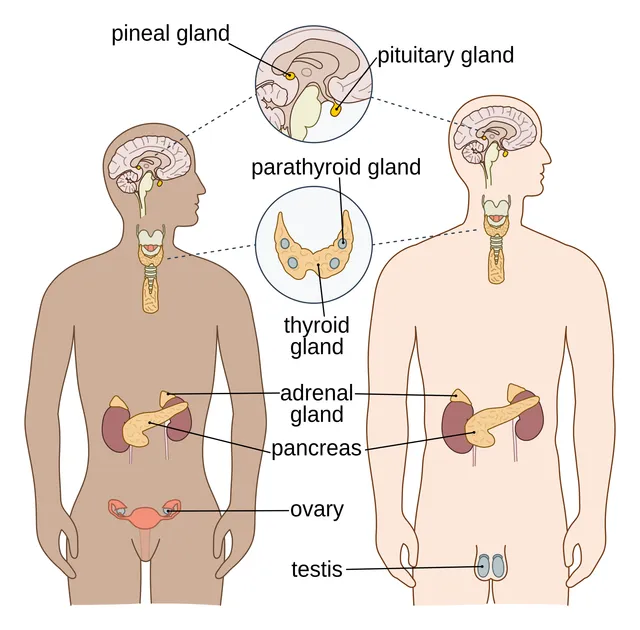
The pituitary, lodged beneath the brain, combines two glands of different origin. The anterior pituitary is a true gland, linked to the hypothalamus by a vascular system, the portal system: hypothalamic neurons release releasing or inhibiting hormones into it, which reach the anterior pituitary cells directly. It secretes six main hormones: growth hormone, prolactin, TSH for the thyroid, ACTH for the adrenal, FSH and LH for the gonads.
The posterior pituitary is merely an extension of hypothalamic neurons: antidiuretic hormone and oxytocin are made in the hypothalamic cell bodies, carried along the axons and released into the blood at the posterior pituitary.
Prolactin is the exception to the rule. It is constantly held back by hypothalamic dopamine. If the stalk linking hypothalamus and pituitary is compressed, all anterior pituitary hormones fall, except prolactin, which rises. Drugs that block dopamine, such as many antipsychotics, likewise raise prolactin, sometimes with milk discharge and loss of periods.
How a hormone acts
Water-soluble hormones — peptides such as insulin, catecholamines — do not cross the membrane. They bind to a surface receptor, which triggers intracellular messengers: a G protein-coupled receptor produces cAMP, for example, while the insulin receptor is itself an enzyme, a tyrosine kinase. The effect occurs within seconds or minutes.
Lipid-soluble hormones — steroids, thyroid hormones, the active form of vitamin D — cross the membrane and bind to intracellular receptors, which act as transcription factors and change gene expression. Their effect takes hours.
In the blood, lipid-soluble hormones travel largely bound to carrier proteins. Only the small free fraction is active and can enter cells. Any change in carrier proteins, for example with oestrogens or during pregnancy, therefore alters the total level without necessarily changing the active fraction: measuring the free form is preferred.
The thyroid
The thyroid takes up iodine from the blood and incorporates it into a large protein stored in its follicles, thyroglobulin. It releases mostly T4, which is essentially a reserve: tissues convert it into T3, the active form, by removing one iodine atom. Thyroid hormones speed up the metabolism of almost all cells, increase heat production and are essential for brain development in the fetus and infant.
This is why congenital hypothyroidism is screened for in every newborn: treated in the first weeks, it does not prevent normal development; missed, it leads to permanent intellectual disability. Worldwide, iodine deficiency remains the leading preventable cause of intellectual disability.
In adults, hyperthyroidism causes a fast heart, weight loss despite a good appetite, tremor and heat intolerance; its most common cause is Graves' disease, in which antibodies stimulate the TSH receptor. Hypothyroidism causes the opposite: fatigue, feeling cold, weight gain, constipation; it is often due to autoimmune thyroiditis. The first test is TSH, which changes markedly for small changes in thyroid hormones.
The adrenal cortex
The adrenal cortex is organised in three layers. The outermost, the zona glomerulosa, secretes aldosterone, under control of the renin-angiotensin system and potassium. The zona fasciculata, in the middle, secretes cortisol, under control of ACTH. The zona reticularis, the deepest, secretes androgens.
Cortisol is a hormone of adaptation to stress. It raises blood glucose by stimulating glucose production by the liver, breaks down muscle proteins to supply the raw materials, and restrains inflammation and immunity. Its synthetic derivatives, corticosteroids, are powerful anti-inflammatory drugs for this reason. Their prolonged excess, or that of cortisol in Cushing's syndrome, causes obesity of the trunk and face, muscle wasting, thin skin, osteoporosis, diabetes and hypertension.
Adrenal insufficiency, or Addison's disease when adrenal in origin, combines fatigue, weight loss, low blood pressure and, through lack of aldosterone, sodium loss and potassium retention. ACTH, no longer held back, rises and darkens the skin. During stress, an acute crisis can occur: this is a life-threatening emergency, treated with hydrocortisone.
The two main forms of diabetes
Diabetes is defined by a fasting blood glucose of at least 7 mmol/L, or 1.26 g/L, on two occasions. Glycated haemoglobin, the fraction of haemoglobin to which glucose has bound, reflects the average blood glucose over the previous two to three months, the lifespan of red cells: it is used mainly to monitor treatment control.
Type 1 diabetes, which often begins in children or young adults, is an autoimmune disease that destroys the beta cells of the pancreatic islets. Insulin is completely lacking: insulin treatment is vital from diagnosis. Without insulin, fats are broken down massively and the liver produces acidic ketone bodies: this is ketoacidosis, which may be the presenting sign.
Type 2 diabetes, by far the most common, combines reduced tissue sensitivity to insulin, favoured by excess abdominal weight and inactivity, and insulin secretion that gradually fails. Silent for a long time, it is often discovered late, sometimes through its complications: damage to the eyes, kidneys, nerves and arteries. Physical activity and weight loss are the first treatment.
58 answered questions go with this chapter in the practice section.
Sources and further reading
Reference textbooks
- John E. Hall, Michael E. Hall, Guyton et Hall. Physiologie médicale, Elsevier Masson.
Open access
- 17.1 An Overview of the Endocrine System — OpenStax, Anatomy and Physiology 2e.
- 17.3 The Pituitary Gland and Hypothalamus — OpenStax, Anatomy and Physiology 2e.
Last revised : . Text licensed under CC BY-SA 4.0.