Muscle contraction
Sarcomere, excitation-contraction coupling, sliding filaments.
The sarcomere
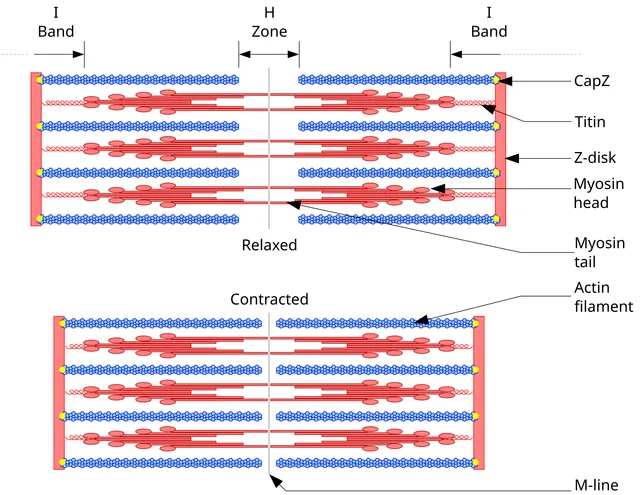
The sarcomere, the contractile unit, extends from one Z line to the next. It combines thin actin filaments and thick myosin filaments whose overlap creates the alternating light and dark bands.

Sliding, not shortening
During contraction, neither actin nor myosin shortens: the filaments slide over one another. The sarcomere shortens, while the dark band keeps its length.
The cross-bridge cycle consumes ATP at every detachment. This is why the loss of ATP after death locks the cross-bridges in place: this is rigor mortis.
Excitation-contraction coupling
The action potential travels along the T tubules to the core of the fiber, where it triggers the release of calcium stored in the sarcoplasmic reticulum.
Calcium binds to troponin, shifts tropomyosin and uncovers the binding sites on actin. Relaxation requires calcium to be actively pumped back into the reticulum: it too costs energy.
Grading the force of a muscle
A muscle fiber responds to each action potential with a complete twitch, following the all-or-nothing law: it does not grade the intensity of its response to a single stimulus. A whole muscle, however, grades its force finely. It has two levers for this.
The first is recruitment: the nervous system activates a growing number of motor units. The smallest, slow and fatigue-resistant, are recruited first; the largest, powerful and fatigable, only for intense efforts.
The second is firing frequency. If a new action potential arrives before complete relaxation, the twitches add up. At a high enough frequency, they fuse into a sustained contraction, physiological tetanus, whose force far exceeds that of a single twitch.
The cross-bridge cycle, in four steps
At rest, the myosin head has already hydrolysed an ATP molecule: it holds the ADP and phosphate and stands cocked, like a stretched spring. When calcium frees the binding sites on actin, the head attaches.
Attachment leads to release of the phosphate, which triggers the power stroke: the head pivots and pulls the actin filament about ten nanometres towards the centre of the sarcomere. ADP is then released, and the head stays bound to actin in the so-called rigor state.
A new ATP molecule then binds to the head and detaches it from actin. Its hydrolysis re-cocks the head, ready for a new cycle, as long as calcium remains present. Each head repeats this cycle several times per second, and thousands of heads work out of step, so that the filament never slips back.
- The cocked head (ADP + Pi) attaches to actin.
- Phosphate release: power stroke.
- ADP release: rigor state.
- ATP binding: detachment; hydrolysis: re-cocking.
Force, velocity and types of contraction
A muscle cannot be both very strong and very fast. The heavier the load, the more slowly it shortens; against a load equal to its maximum force, it no longer shortens at all. This is the force-velocity relationship. Power, the product of force and velocity, is greatest for an intermediate load, about a third of maximum force.
Three modes of contraction are distinguished. In isometric contraction, the muscle develops force without changing length, as when holding an object at arm's length. In concentric contraction, it shortens while working, as the biceps does when lifting a load. In eccentric contraction, it lengthens while developing a force that brakes the movement, as the quadriceps does when walking downhill.
Eccentric contraction produces the highest force for the least energy, but damages the fibres more: it is mainly what causes delayed muscle soreness, pain that appears one to two days after unaccustomed exercise.
The energy systems
Muscle stores only a little ATP, enough for two or three seconds. Phosphocreatine regenerates it at once, without oxygen, by giving its phosphate to ADP: it covers very intense efforts of about ten seconds, such as a sprint.
Beyond that, anaerobic glycolysis breaks down muscle glycogen into lactate. Fast but inefficient, it fuels intense efforts of one to two minutes. Lactate is not a waste product: it is reused by the heart, by other fibres and by the liver. Nor is it responsible for soreness in the following days.
For prolonged efforts, oxidation of carbohydrates and fats in the mitochondria supplies most of the ATP, with a much higher yield, but at a rate limited by oxygen delivery. Maximal oxygen consumption, or VO2max, measures a person's aerobic capacity; it improves with endurance training.
After exercise, oxygen consumption stays high for a few minutes: it is used to rebuild phosphocreatine, reload myoglobin with oxygen and clear lactate.
Spinal reflexes
The muscle spindle, a stretch sensor lodged among the muscle fibres, informs the spinal cord through fast type Ia fibres. When the muscle is suddenly stretched, these fibres directly excite, through a single synapse, the motor neurons of the same muscle, which contracts: this is the stretch reflex, which doctors elicit with a hammer. At the same time, through an inhibitory interneuron, the antagonist muscle is relaxed: this is reciprocal inhibition.
Small motor neurons, called gamma, adjust the tension of the spindle itself and maintain its sensitivity as the muscle shortens. The Golgi tendon organ, at the junction of muscle and tendon, detects tension and, through Ib fibres and an inhibitory interneuron, restrains the muscle when force becomes excessive.
Examining the reflexes tells us the level of a lesion. The knee jerk tests mainly the L3 and L4 roots, the ankle jerk the S1 root. Damage to the nerve or root abolishes the reflex. Damage to the central motor pathway, which no longer restrains the motor neurons, makes them brisk and widespread instead, with stiffness that increases with the speed of stretch: this is spasticity.
Losing muscle
Muscle adapts to use in both directions. Immobilisation, a cast or bed rest, quickly melts muscle mass: fibres lose myofibrils and strength falls markedly within a few weeks. In older people in hospital, a few days of bed rest can be enough to compromise walking.
With age, a gradual loss of muscle mass and strength sets in, especially after fifty: this is sarcopenia. It particularly affects fast fibres, which protect against falls by allowing a person to catch themselves. Physical activity, especially resistance exercise, and enough protein slow it down.
58 answered questions go with this chapter in the practice section.
Sources and further reading
Reference textbooks
- John E. Hall, Michael E. Hall, Guyton et Hall. Physiologie médicale, Elsevier Masson.
Open access
- 10.3 Muscle Fiber Contraction and Relaxation — OpenStax, Anatomy and Physiology 2e.
Last revised : . Text licensed under CC BY-SA 4.0.